Law students arrive from a humanities background, and a lecture about cryptographic hashing gives them nothing to reason with. They can repeat the definition. They cannot yet tell you what would go wrong, which is the only thing a lawyer is actually paid for. The gap is not that the concepts are hard; it is that text conveys no intuition for mechanism.
Two modules, both open source
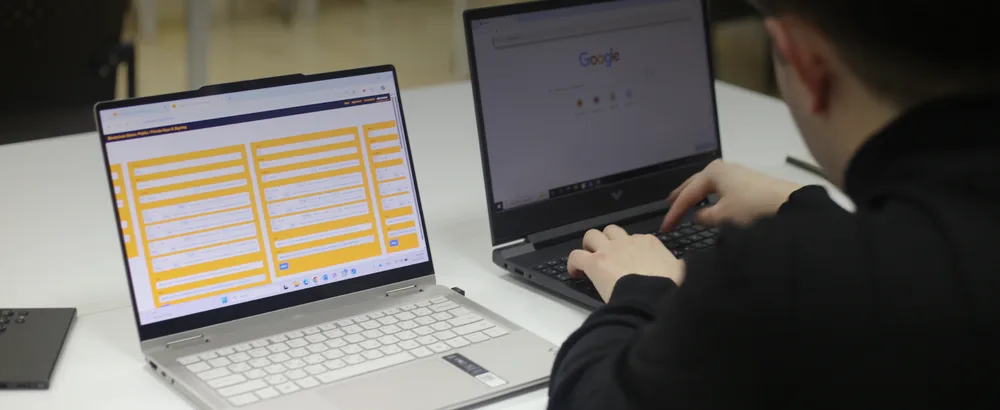
The Lab teaches this with two interactive modules, both adapted from the MIT-licensed demonstrations built by Anders Brownworth and used with attribution under that licence. One is a blockchain simulation: blocks, hashes, a chain that visibly breaks when you alter a record and then repairs as you re-mine it. The other covers public and private keys: signing a message, verifying a signature, and watching verification fail the moment the message changes by one character.
Neither is sophisticated software, and that is the point. They are small enough to grasp in a seminar and honest enough to show the mechanism rather than a marketing diagram of it.
What changes in the seminar
Before, the discussion stalled at description. Afterwards it can start at evaluation. Students simulate transactions across settings – a real estate transfer, a maritime shipment – and are asked the question that matters: where does this mechanism genuinely improve on a conventional contract, and where does it merely relocate the problem?
That question is unanswerable without a working mental model, and it is trivial to answer badly with one that is wrong. Having tampered with a block and watched the chain reject it, a student stops treating immutability as a slogan and starts treating it as a property with costs.
The limit of a simulator
A simulator teaches mechanism, not consequence. It will show a student exactly how a ledger behaves and tell them nothing about whether a smart contract is enforceable under Georgian law, what happens when the external data feed a contract relies on is simply wrong, or who bears the loss when code executes precisely as written and precisely against what the parties intended.
Those are the lawyer’s questions, and they only become teachable once mechanism is out of the way. Clearing that obstruction is the whole function of the tool. Mistaking the tool for the subject would be the error.
Where it leads
Simulation is the first stage of the Lab’s clinical model, not the end of it. Students work on constructed scenarios where a wrong answer costs nothing, and once a cohort handles those reliably the Lab brings in real problems from companies and public bodies for the same teams to work on under supervision. A simulator is where a student learns that a mechanism has properties. A real process is where they learn that an organisation has constraints. Both are necessary, and the order is not interchangeable.
The classroom use described here was reported by Entrepreneur Georgia on 9 March 2026, პირველად საქართველოში – სამართლის სწავლება ბლოკჩეინ სიმულატორის გამოყენებით.